
Kintock Legacy Program Record Scope
The NJDOC RCRP directory identifies Kintock Bridgeton Legacy Program as one of the Bridgeton community-release programs. The official research does not supply a separate Legacy street address, telephone number, operating schedule, population figure, or public release desk. Those details must not be borrowed from Kintock Bridgeton I, which has its own sourced address and phone.
Legacy's governing record family is NJDOC. Cumberland County Jail's current-person gateway is not a locator for the program, even though both are in Cumberland County. The person's state incarceration history, date fields, current facility, and any later SPB event provide the supported release trail.
NJDOC-listed Residential Community Release Program
Location supported by research: Cumberland County, New Jersey
Separate street address and phone: not verified
Public release route: NJDOC offender search and SPB when parole follows
Kintock Legacy Placement Is Not Discharge
A transfer into Legacy can occur before the sentence or state correctional jurisdiction ends. “Community release” in the program category describes the placement model, not an unconditional release finding for each resident. The state may still control the correctional status, and a later event determines whether the person went to parole, maximum discharge, another program, or renewed institutional custody.
| Event | What can be stated | What cannot be assumed |
|---|---|---|
| Move into Legacy | NJDOC recorded an RCRP transition. | The sentence ended. |
| Move to another facility | The state placement changed. | The person entered the community without conditions. |
| Parole release | Confinement ended and SPB supervision followed. | Correctional jurisdiction ended. |
| Maximum discharge | The state correctional term ended as shown in the official history. | No later unrelated custody exists. |
| Return to custody | A later state event followed an earlier exit. | The older release date was false. |
A precise result names the facility or program left and the status that followed. Avoid the vague word “free.” It hides whether supervision, transfer, or another custodian remained.
VINE may add a custody-change notice for covered New Jersey records, but the alert still needs agency confirmation. Preserve whether the notice says release, transfer, court movement, or a parole action. Each label points to a different next record.
Search Kintock Legacy Release History
Use the official NJDOC offender search. A full name is the starting point, and an SBI number is the strongest public identifier when known. Confirm the match through aliases, county of commitment, case information, and the latest incarceration period. A program's physical presence in Bridgeton does not mean the person was committed from Cumberland County.
- Locate the correct person in NJDOC, using the SBI number when available.
- Open the full record and read the most recent incarceration history.
- Identify whether Legacy appears as a placement or whether another current facility is listed.
- Find `Date Out-of-Custody` and compare it with every later admission or return.
- Keep forecast and eligibility fields separate from an actual exit event.
- Ask SPB about supervision when the state history indicates parole.
- Request agency records when the public screen does not show the destination or event type.
Kintock Legacy Release Date Fields
NJDOC uses exact terms. `Date Out-of-Custody` is the date released from a custody period. `Current Max Release Date` is the latest calculated maximum date after earned days and days added for negative institutional conduct; NJDOC warns that it can change at the end of each month. `Current Parole Eligibility Date` is an expected eligibility threshold under SPB calculations and procedures.
Neither future field guarantees departure from Legacy or any other placement. Eligibility means the person can be considered under the parole process. A panel can grant release for a later date, deny release and set a Future Eligibility Term, or rescind a grant if new information appears before release. The NJDOC field definitions should control how each label is described.
- Date Out-of-Custody
- Historical evidence of release from the stated custody period.
- Current Max Release Date
- A changing calculation, not a guaranteed exit day.
- Current Parole Eligibility Date
- An eligibility marker, not approval or release.
- Incarceration History
- The sequence needed to spot later returns and new admissions.
Kintock Legacy Parole Confirmation
The New Jersey State Parole Board handles parole. Probation belongs to the Judiciary and should not be merged into the same lookup. No official public person-level SPB supervision database was found. For a named parole question, use NJDOC first and then contact `SPB-Public-Info-Office@spb.nj.gov` with enough identifiers to prevent a mistaken match. SPB's central number is 609-292-4257.
The weekly Parole Eligibility Notice is useful history, but it is not an exact appointment calendar or universal current-supervision roster. It can show county of commitment, current location, sentence details, jail credit, and event strings such as `RELEASED`, `REVOKED`, and `RET CUSTODY`. Its county blocks follow commitment geography, not facility geography.
Parole can follow a Kintock placement without ending all state jurisdiction. Conditions and reporting continue. A later revocation can return the person to custody, so current confirmation must account for events after the initial release.
Request Kintock Legacy Records
When the public search does not explain the transition, request existing NJDOC records tied to the state custody episode. Include the full name, SBI number, date of birth if known, and a narrow date range. Seek incarceration history, movement or placement records, and discharge material that can identify the event after Legacy. Ask for the record's own codes and labels instead of asking the custodian to decide whether the person was unconditionally released.
A separate SPB request may be needed for a parole decision or supervision-status record where disclosure is allowed. NJDOC and SPB can redact confidential victim, security, medical, juvenile, sealed, or other exempt material. A missing public field does not prove that the underlying agency record was destroyed.
Cumberland County OPRA is the correct route for county records, not NJDOC history. Use it only if a county record is independently relevant. Sending a Legacy request to the county jail can produce the wrong answer because the county roster does not own state RCRP placement data.
Kintock Legacy Reentry Navigation
Local reentry resources can help after the legal event is clear. Cumberland County names Re-Entry Coordinator Eugenio Portalatin at 856-453-4549 on the county jail services page. Kintock Legacy remains an NJDOC transition program, while the county coordinator is a local navigation contact. Neither source alone proves that a particular person has discharged or begun parole.
The Cumberland County Guidance Center describes a Mental Health Justice Involvement program for eligible residents with serious mental illness involved with jail, court, or probation. Its materials say staff can follow eligible participants into the community immediately after release, and the listed contact is 856-825-6810 extension 295.
Keep service entry separate from correctional status. First establish the latest NJDOC event. Then use the appropriate local service or supervising office for the next practical need.
Legacy Transfers in Cumberland History
Cumberland County's correctional footprint makes transfer language especially important. South Woods and Bayside remain operating NJDOC prisons. Southern State fully closed July 1, 2022, and NJDOC says its population was absorbed through consolidation involving nearby state facilities. Losing the old Southern State facility label did not mean those people were released.
Cumberland County also announced a 2025 agreement for the planned Southern New Jersey Rehabilitation and Reentry Center after an earlier jail-build effort ended. The supplied research does not confirm that the regional center opened or received detainees. It is local context, not an active search destination.
The county's regional-facility source illustrates why future plans must stay separate from a present Kintock Legacy release check.
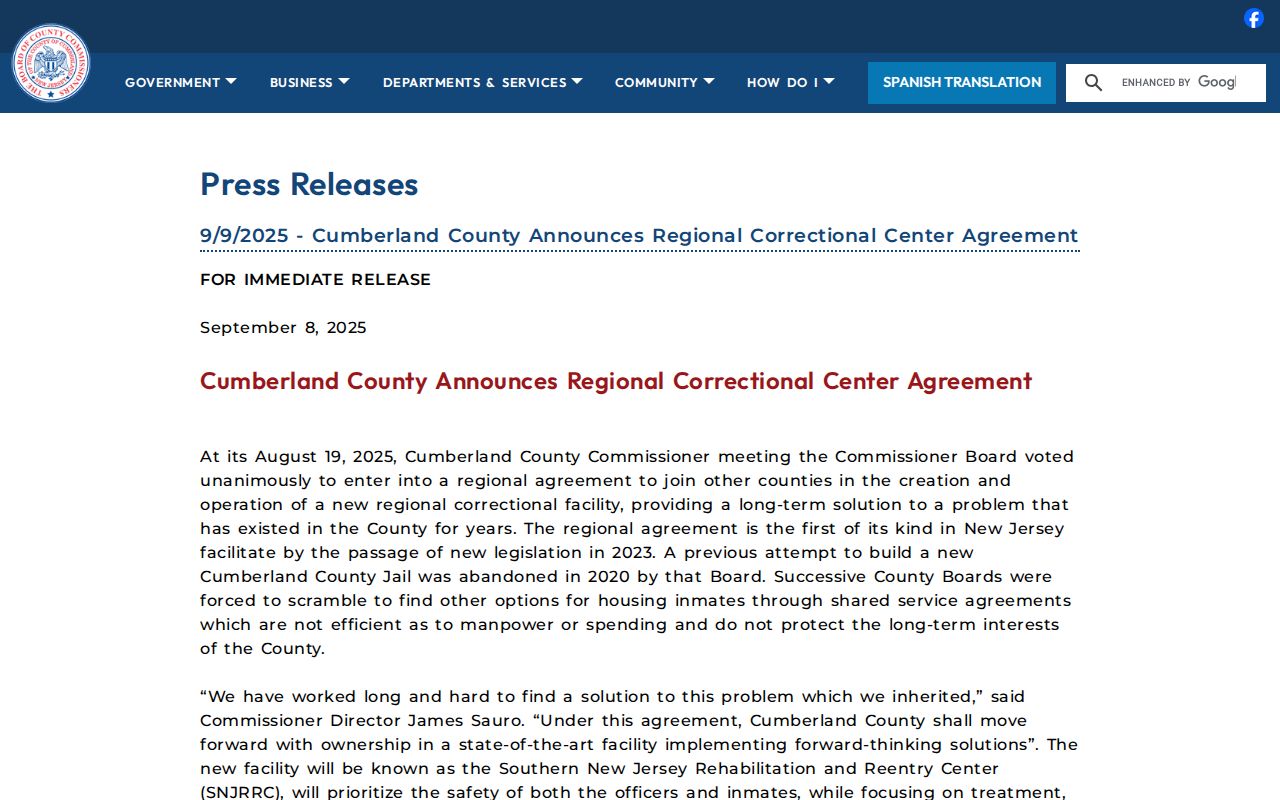
That announcement supplies transfer and regionalization context, not proof that the planned center now holds or releases anyone.
Legacy fits inside this layered map as an NJDOC RCRP. A change from prison to Legacy, from Legacy to another program, or from Legacy back to an institution is a state movement until the record establishes parole or discharge. Follow the event, not just the place name.
Kintock Legacy and County Custody
Kintock Bridgeton Legacy Program is not Cumberland County Jail. The county jail handles local pretrial and county custody, and its release record can identify bail, court action, time served, completion, or transfer. Legacy belongs in NJDOC's state history. The Cumberland County released-inmate record path helps separate those systems when a family does not know which agency last held the person.
New Jersey VINE can provide a custody-change notification for covered state and county records, but an alert is not a certified discharge record. Federal BOP and ICE systems remain separate. No single county search covers every facility located in Cumberland County.
Note: An RCRP's community setting does not establish maximum discharge, unconditional release, or freedom from parole supervision.