
Cumberland Scheduled and Actual Release
A scheduled or calculated date forecasts when one legal term may end. An actual release date records departure from a custody period. NJDOC calls its central future field Current Max Release Date. It calls the historical event Date Out-of-Custody. Those labels should not be blended.
A person awaiting trial at Cumberland County Jail may not have a sentence-based date at all. Bail can be posted, a judge can enter an order, or another agency can place a hold. Staff must still clear warrants and complete release processing. A sentenced county inmate may have a calculation governed by the judgment and applicable rules, but Cumberland’s public lookup does not publish a local projected-date field or formula.
For a state prisoner, Current Parole Eligibility Date answers a third question. It is the expected threshold for State Parole Board consideration. Eligibility is not a grant, and a grant may set a later release date with conditions. A later admission or revocation can also follow a valid historical release.
Find a Cumberland Projected Release Date
Classify the custody episode before searching. South Woods and Bayside are NJDOC prisons even though they are in Cumberland County. Cumberland County Jail is a county facility. FCI Fairton is federal. Each record system answers a different date question.
- Identify the facility and sentence type. Separate pretrial detention, a county term, a New Jersey state sentence, and a federal sentence.
- For NJDOC custody, open the official offender search. Search by a specific name or SBI number.
- Confirm identity through aliases, county of commitment, case or offense information, and the latest incarceration history.
- Read Current Max Release Date and Current Parole Eligibility Date separately. Check mandatory-minimum and maximum-term information where shown.
- For Cumberland County Jail, contact the jail or sentencing court for the governing calculation. Ask for an existing record rather than a new estimate.
- After departure, confirm Date Out-of-Custody or the county release sheet, then check for a later admission, transfer, or supervision event.
The NJDOC official field definitions are captured below.
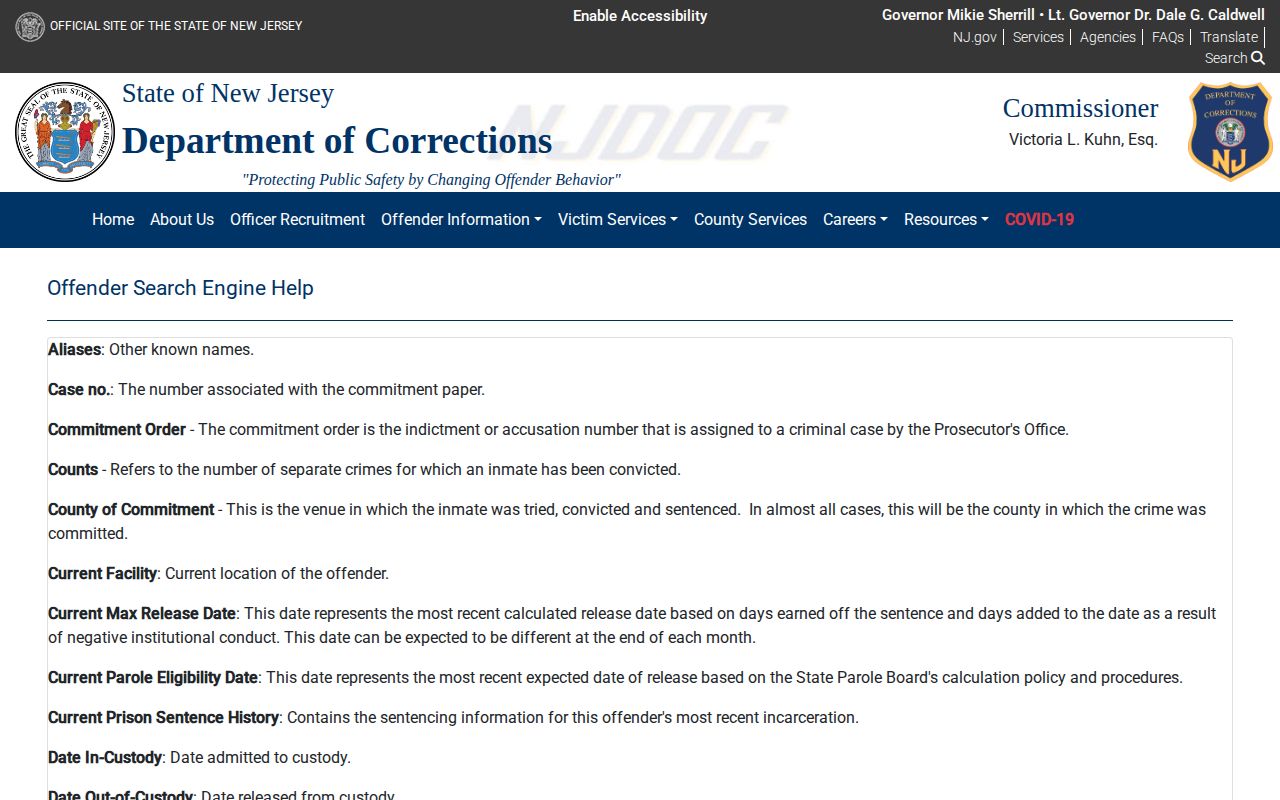
The state definitions make clear that the maximum release calculation can change and that parole eligibility is a separate date with a different legal purpose.
The Cumberland County released-inmate search path supplies the wider records chain when the facility or destination is uncertain.
Cumberland Release Credits and Minimums
New Jersey does not use one flat good-time percentage for every sentence. Under N.J.S.A. 30:4-123.51, an ordinary adult term generally reaches parole eligibility after one-third unless a period of parole ineligibility applies. The SPB calculation guide distinguishes a “book” eligibility point from an “actual” point after lawful credits.
Jail credit is time awarded by the sentencing court for qualifying pre-sentence custody. Progressive commutation credit is governed by N.J.S.A. 30:4-140. The schedule is progressive, not a single percentage, and misconduct can cause forfeiture. Rules also allow restoration in appropriate circumstances.
N.J.S.A. 30:4-92 governs work and minimum-custody credits. SPB’s guide describes work credit as one day per five days worked. It describes minimum-custody credit as three days per month in the first year in minimum status and five per month afterward. Actual credit depends on classification, work, conduct, and the law that applies to the sentence. It should never be forecast from the outside as guaranteed.
Mandatory minimums take priority. NJDOC defines the mandatory minimum as the term that must be satisfied before release, less court-awarded credits. Commutation, work, and minimum-custody credits cannot move eligibility ahead of that minimum unless the law permits it.
N.J.A.C. 10A:9-5 addresses commutation and work time, including forfeiture and restoration. It can also reach state-sentenced people housed in county facilities. Its presence does not supply a simple public calculator. The applicable judgment, classification, work status, disciplinary record, and current agency computation still determine the result.
Maximum Term is another distinct field. NJDOC describes it as the total term under NJDOC or SPB jurisdiction, subject to lawful reductions. This helps explain why a person may be physically outside a prison but still within parole jurisdiction. The public date question should therefore ask both when custody may end and whether supervision follows.
Note: Credit statutes explain NJDOC calculations, but the current agency record remains the source for a particular Cumberland release date.
Why Cumberland Release Dates Change
A date can move for lawful reasons. NJDOC says the Current Max Release Date may differ at the end of each month when earned days and negative institutional conduct are posted. A changed display is not, by itself, an error.
| Factor | Possible effect | Record to check |
|---|---|---|
| Court jail-credit correction | Changes credited time | Judgment or later court order |
| Monthly earned credit | May move the calculated maximum date | NJDOC offender detail |
| Discipline | Can cause credit forfeiture | NJDOC calculation or records response |
| Credit restoration | Can restore time under applicable rules | NJDOC calculation history |
| Concurrent or consecutive sentence | Changes how multiple terms combine | Sentencing judgment and NJDOC history |
| Parole denial | Can create a Future Eligibility Term | SPB decision or eligibility notice |
| Detainer or hold | May change the destination, not the sentence end | Custody movement record |
A detainer is a request or legal basis for another authority to take or continue custody. It can mean the person leaves one facility but does not enter the community. Court orders, new sentences, and a parole rescission can also change the sequence. Always describe which agency the person left.
Concurrent sentences run together to the extent ordered. Consecutive sentences run one after another. The judgment and NJDOC history show which structure applies. A summary that sees several terms but ignores that relationship can produce a date that is far from the official calculation.
Confirm a Cumberland Release Date
For a completed state-prison custody period, Date Out-of-Custody is the strongest public NJDOC field. Compare it with current facility information and later incarceration history. An old date remains historically true even if the person returned to custody.
Incarceration History is especially important because it groups periods within the most recent incarceration. Date In-Custody marks admission, while Date Out-of-Custody marks release from that period. Current facility information can reveal that a newer custody episode exists. Searchers should also compare aliases, case number, commitment order, county of commitment, sentence date, sentence length, offense date, and mandatory minimum where those fields are visible.
For a Cumberland County Jail departure, request the release sheet or custody movement record. Ask for actual date and time, release type or disposition, and destination agency if transferred. A court order explains legal authority, while the jail record documents physical processing. The two times may not match.
If bail is involved, payment is one step rather than the release time. Cumberland staff check warrants, prepare recognizance paperwork, collect payment and fees, issue a receipt, and then send the name to the Issue officer for release. The county warns that waiting time varies. A payment receipt should never be published as the moment the person left the building.
New Jersey VINE release alerts can give timely notice for county and state custody changes. A transfer alert is not community release, and VINE is not the certified discharge record. For parole, SPB confirmation is needed because release to supervision and final discharge are separate events.
A federal person at FCI Fairton belongs in the BOP locator, not NJDOC. A past BOP release date can confirm exit from BOP, but another jurisdiction or federal supervision may follow. Cumberland geography never changes which agency owns the sentence record.
Cumberland NERA Release Calculations
The No Early Release Act, N.J.S.A. 2C:43-7.2, requires an 85 percent parole-ineligibility minimum for enumerated first- and second-degree crimes. It does not mean every New Jersey prisoner must serve 85 percent. The sentencing judgment identifies whether the statute applies and fixes the minimum.
For the statute’s calculation, a life term is treated as 75 years. Court-awarded credit still must be read from the judgment and official computation. A person released after a covered term may then serve parole supervision. Physical exit therefore does not necessarily mark final discharge from jurisdiction.
Use the offense, judgment, mandatory-minimum field, and current NJDOC calculation together. A broad estimate based only on sentence length can miss mandatory terms, jail credit, consecutive sentences, and later orders.
Ordinary eligibility and NERA must not be blended. The one-third baseline applies only when no controlling minimum displaces it. The 85 percent rule applies only to the enumerated offenses in its statute. A court record identifies the sentence that was imposed; NJDOC and SPB then maintain the official calculation and eligibility records.
Cumberland Current Max Release Date
NJDOC’s exact label is Current Max Release Date, not a generic “projected date.” It is based on days earned off the term and days added for negative institutional conduct. NJDOC warns that the field may change at the end of each month. Preserving that label helps readers avoid mistaking a live calculation for an appointment.
| Official field | Meaning | Proof of release? |
|---|---|---|
| Current Max Release Date | Current calculated maximum date, sensitive to credits and discipline | No |
| Current Parole Eligibility Date | Expected threshold for SPB consideration | No |
| Date Out-of-Custody | Historical date released from a custody period | Strong evidence, subject to later admissions |
Cumberland’s county lookup has no equivalent public date field. No official county weekend-release rule, Friday-before-Sunday policy, fixed daily release hour, or local good-time formula was found. The sentencing court and jail must supply the actual governing calculation rather than importing a state-prison rule into every county booking.
A county sentence also needs its own legal context. N.J.S.A. 30:4-123.51 contains county-inmate parole-eligibility provisions, and Title 10A rules can affect a state-sentenced person housed in a county facility. That does not make a pretrial bail hold, municipal sentence, county term, and state sentence interchangeable. Ask the court or Cumberland jail for the record that states which term and credits govern.
When a date is disputed, preserve the source and observation date. Compare the court judgment, NJDOC detail, and any later agency response. A current screenshot can show what the state calculated on that day, while a later screenshot may reflect new monthly postings. The difference can be evidence of a revised calculation rather than evidence that either image was fabricated.
Parole adds another checkpoint. A two-member SPB panel may grant or deny release when panel review is required. A denial can set a Future Eligibility Term. A grant sets a future release date and may add conditions, but new information before departure can lead to a rescission hearing. For that reason, Current Parole Eligibility Date, a parole grant, and Date Out-of-Custody answer three distinct questions. The actual custody history remains the final check.
Note: The lack of a Cumberland weekend rule is a research finding, so no schedule from another county should fill that gap.